The Implications of China's Growing Military Power: Part 1 - The myth of the threat
"Sure. China. Yeah, so under this scenario we're spending close to 30 billion dollars a year to protect our trade with China from China. And that doesn't strike anyone at this table as odd." [1]
Utopia satirises our strategic posture
In the brilliant episode of Utopia on Australia's Defence Policy, Season 3 Episode 7: On "The Defence", Tony attempts to extract from the ‘top brass’ (the highest-ranking officers) from the Army, Navy and Airforce the details of Australia's defence policy.
Utopia, ABC
Tony: I thought the best way to proceed was to get everyone in the one room. (Good. Thank you.) Okay. All right. I'll come straight to the point. This white paper is recommending we spend close to 400 billion dollars over the forward estimates. At some point the PM is going to be asked a very simple question. In order to protect us from which enemy? ...
General: It's ...it's so hard to say.
Tony: 400 billion. Pick one.
Colonel: A regional player.
Tony: Specifically, Colonel.
General: An indo-pacific regional ...
Tony: Please, more specifically.
General: Indo-asia Pacific...
Tony: That's broader. Who are you leaving out? ...
Colonel: Europe.
Tony: Yeah. I sort of need a country ...
Colonel: or an unaligned player.
Jim: No, country. One that might threaten us. Just one.
Tony: Yeah.
Colonel: I wouldn't want to raise tensions.
Tony: Where? ...
Colonel: In this room.
Tony: You know what. I'll name one and you just nod. China. (Colonel nods) ...
Tony: Yep, okay and what exactly are we protecting? ...
Colonel: Strategic interests.
Tony: Specifically, Colonel.
General: Indo-pacific strategic ...
Tony: Really specifically.
General: Indo Asia-Pacific strategies.
Tony: You know what. I'll say it and then you nod. Our trade routes? (Nodding) Yeah and who is our number one trading partner? ...
Jim: Shall we use nods? ...
Tony: Sure. China. Yeah, so under this scenario we're spending close to 30 billion dollars a year to protect our trade with China from China. And that doesn't strike anyone at this table as odd.
General: It's ...it's so hard to say.
Tony: 400 billion. Pick one.
Colonel: A regional player.
Tony: Specifically, Colonel.
General: An indo-pacific regional ...
Tony: Please, more specifically.
General: Indo-asia Pacific...
Tony: That's broader. Who are you leaving out? ...
Colonel: Europe.
Tony: Yeah. I sort of need a country ...
Colonel: or an unaligned player.
Jim: No, country. One that might threaten us. Just one.
Tony: Yeah.
Colonel: I wouldn't want to raise tensions.
Tony: Where? ...
Colonel: In this room.
Tony: You know what. I'll name one and you just nod. China. (Colonel nods) ...
Tony: Yep, okay and what exactly are we protecting? ...
Colonel: Strategic interests.
Tony: Specifically, Colonel.
General: Indo-pacific strategic ...
Tony: Really specifically.
General: Indo Asia-Pacific strategies.
Tony: You know what. I'll say it and then you nod. Our trade routes? (Nodding) Yeah and who is our number one trading partner? ...
Jim: Shall we use nods? ...
Tony: Sure. China. Yeah, so under this scenario we're spending close to 30 billion dollars a year to protect our trade with China from China. And that doesn't strike anyone at this table as odd.
Threats or fault lines?
Kishore Mahbubani’s article, “2024: The start of another surprise war?”, from January 4, 2024 is sobering as well as sober. It confronts the reality of the last few years. The year 2022 produced a surprise war: Ukraine. 2023 also produced a surprise war: Gaza. "Anyone who believes that 2024 cannot produce another surprise war should have his or her head examined." [2].We are relieved that 2024 did not surprise us with a war. Regardless of what sober analysis or conspiratorial posture you adopt regarding these conflicts, the unambiguous facts are that they were not expected, but they are shockingly real.
Mahbubani outlines five fault lines in Asia that he thinks could lead to war and that we should monitor carefully (and, if possible, nudge towards peace, rather than war).
Here is a summary of Mahbubani’s fault lines.
Taiwan
Tensions between China and Taiwan are high, especially with a potential pro-independence leader in Taiwan's upcoming election. China considers Taiwan a breakaway province and has threatened war if it declares independence. The US supports Taiwan's autonomy but avoids explicitly backing independence to prevent war with China. The upcoming US elections could further inflame tensions if candidates compete on being "tougher" on China. Mahbubani warns Taiwan that relying solely on US support is risky, as geopolitical interests can shift.
China vs India
China and India, Asia's major powers, have a tense border situation with a history of deadly skirmishes. Despite some progress in border talks, trust remains low and both sides are increasing military presence. A full-blown war seems unlikely, but another accidental clash could escalate tensions and destabilize Asia.
India vs Pakistan
The India-Pakistan border conflict is considered highly dangerous, with some experts believing its closest to a nuclear war. Past US intervention helped prevent escalation, but American influence has weakened in the multipolar world. Mahbubani suggests strong leadership is needed for successful peacemaking efforts.
China vs Japan
Deep historical animosity fuels distrust between China and Japan. Territorial disputes, like the Diaoyutai/Senkaku Islands, are a flashpoint for confrontation. Mahbubani argues for a more moderate Japanese leadership to avoid nationalistic actions that escalate tensions. Democratic systems may favour politicians who exploit these tensions for personal gain, hindering peaceful resolution.
China vs Philippines
This is a relatively new and surprising flashpoint. The Philippines initially aimed to build ties with China due to historical connections. However, tensions over disputed territories in the South China Sea have risen. Some in the Philippines favour closer ties with the US in response. Mahbubani suggests the Philippines learn from Vietnam, which maintains good relations with both China and the US despite similar disputes. Most Southeast Asian nations are trying to navigate a balance of power between the US and China.
Australia's place in Asia
It is not hard to understand that Australia’s place in Asia makes any or all of these fault lines our business. Sadly, the response from Australia has been irrational - just consider AUKUS. We would do well to turn to Mahbubani for a more rational pathway. More than any other time in history, a clear mind and solid facts are important to keep us safe and prosperous.What is a threat?
In the next part of this article, we examine what might constitute a threat.China returns to its proper place
No one in Australia would miss the satire in this piece, highlighting the absurdity of the idea that we need to protect our trade with China from China. Yet, this is precisely what the Australian media, think tanks, and politicians have been promoting for decades. It is this absurdity that has prompted this site - an attempt to uncover the errant nonsense that passes for news, current affairs, documentary or factual accounts of China and the toxic effect this has on all our perceptions and public dealings with China.After 100 years of humiliation under colonisation, China is asserting its rightful place in the world.
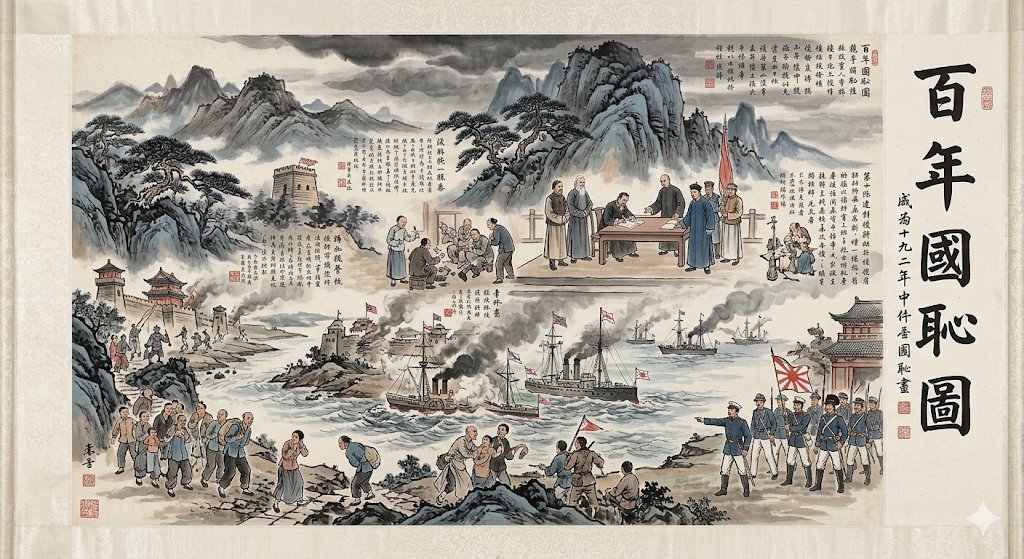
Century of humiliation
Central to the panic emerging in western countries is the failure of capitalism. Capitalism has failed to deliver the bounty that its proponents promised and still promise. The worship of the market as some kind of deity has been shown to be a religious delusion and the inherent flaws of democracy and liberty have been exposed.
As capitalism fails, a strident and absurd propaganda program to misdirect the attention of the public from decaying economies has been developed. China stands as an exemplar of the success of communism with Chinese characteristics and its success angers Western commentators, especially those bound by models of development from a colonial era.
Sources
1. Kishore Mahbubani (1 Jan. 2024). 2024: The Start of Another Surprise War?. The Straits Times. http://mahbubani.net/2024-the-start-of-another-sur.... Retrieved 30 Jan 2025.
Kishore Mahbubani outlines five "fault lines" in Asia that could potentially trigger a new conflict..
Kishore Mahbubani outlines five "fault lines" in Asia that could potentially trigger a new conflict..
Claims
Author

Andrew Westerman
I am a retired teacher who has an interest in geopolitics and preventing a war between the US and China